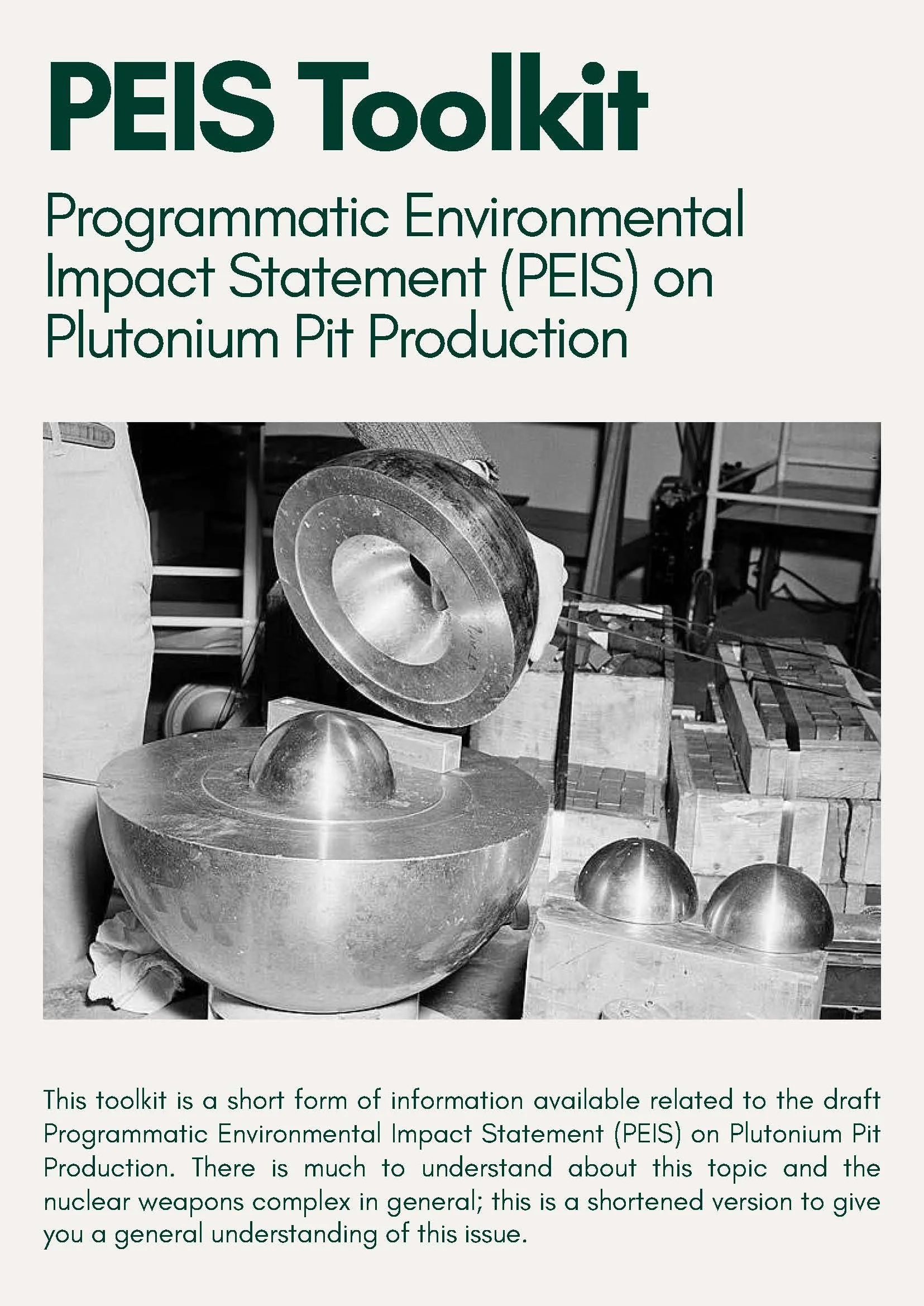
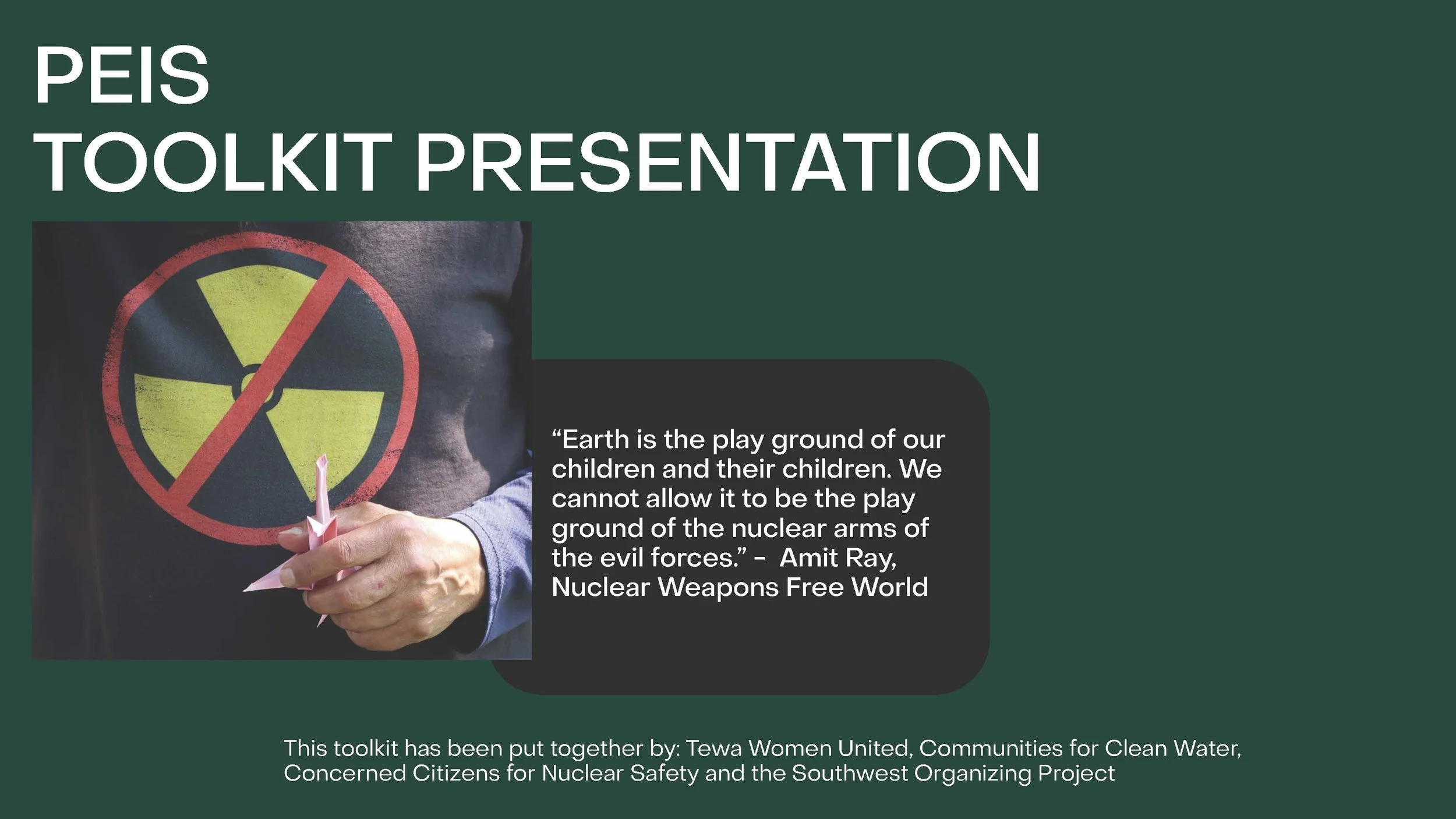
Plutonium Pit Production Programmatic Environmental Impact Statement (PEIS)
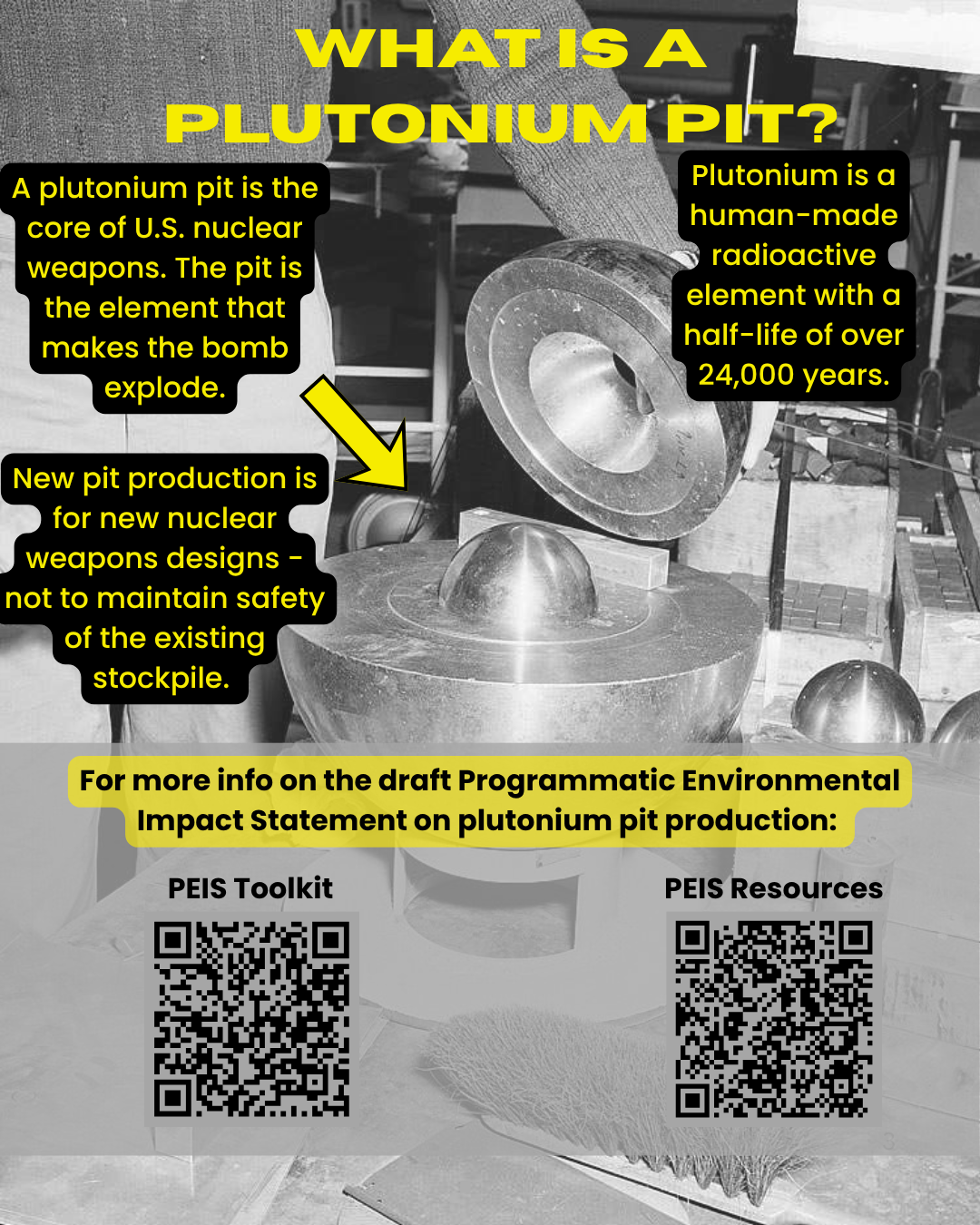
The Draft Plutonium Pit Production PEIS is an Environmental Impact Statement required by the National Environmental Policy Act (NEPA) as a result of the lawsuit against the U.S. Department of Energy (DOE) and the National Nuclear Security Administration (NNSA), which challenged the federal agencies’ decision not to examine the possible wider impacts of Los Alamos National Laboratory (LANL) and Savannah River Site (SRS) in South Carolina producing these warhead triggers, also known as pits.
The Draft Plutonium Pit PEIS assumes that the United States will produce at least 80 plutonium pits per year, and it is comprised of 3 Alternatives:
No-Action Alternative: LANL will produce 30 plutonium pits per year, with the capacity of producing up to 80 pits per year.
Multi-Site Alternative: NNSA would produce 30 plutonium pits per year at LANL (and up to 80), and 50 plutonium pits per year at SRS (up to 125). This is the NNSA’s preferred alternative.
Single-Site Alternative: NNSA would produce plutonium pits at either LANL or SRS. It would be up to 80 pits per year at LANL and 50-125 pits per year at SRS.
The purpose of plutonium pit production is to create more nuclear bombs.
Public Comments Due Midnight on July 16, 2026
〰️
Public Comments Due Midnight on July 16, 2026 〰️

Help us urge the National Nuclear Security Administration (NNSA) to extend the public comment period for the Draft Programmatic Environmental Impact Statement (PEIS) on Plutonium Pit Production until the public has access to critical information necessary for meaningful review and comment.
The NNSA is asking the public to comment on the PEIS, a proposal that would shape U.S. nuclear weapons production for decades. The Draft PEIS would guide plutonium pit production through at least 2075, with significant implications for surrounding communities, Tribal Nations, workers, environmental resources, public health, and federal spending. A decision of this magnitude deserves a review process that is transparent, scientifically complete, and fully informed.
Currently, the NNSA has not released all the required documents for the public to fully evaluate the PEIS impacts.
We ask that you please sign this petition to support government transparency, informed public participation, and a fair environmental review process.
https://actionnetwork.org/petitions/extend-the-public-comment-period-on-expanded-plutonium-pit-production-until-critical-documents-are-released?source=direct_link&
Draft Plutonium Pit Production PEIS Public Comments Due Midnight on July 16, 2026
Email: PITPEIS@NNSA.DOE.GOV
Mail:
Pit Production PEIS Comments
Jade Fortiner
NNSA, Office of Pit Production Modernization 1000 Independence Avenue SW
Washington, DC 20585
MORE RESOURCES:
Visit pitpeis.com
Read the Union of Concerned Scientists Pit Report
Read the CCW PEIS Scoping Comments from 2025
Look through the PEIS Community Resources Google Drive folder
Click on the PEIS Toolkits below
Learn more about Plutonium Pit Production and Environmental Impact Statements:
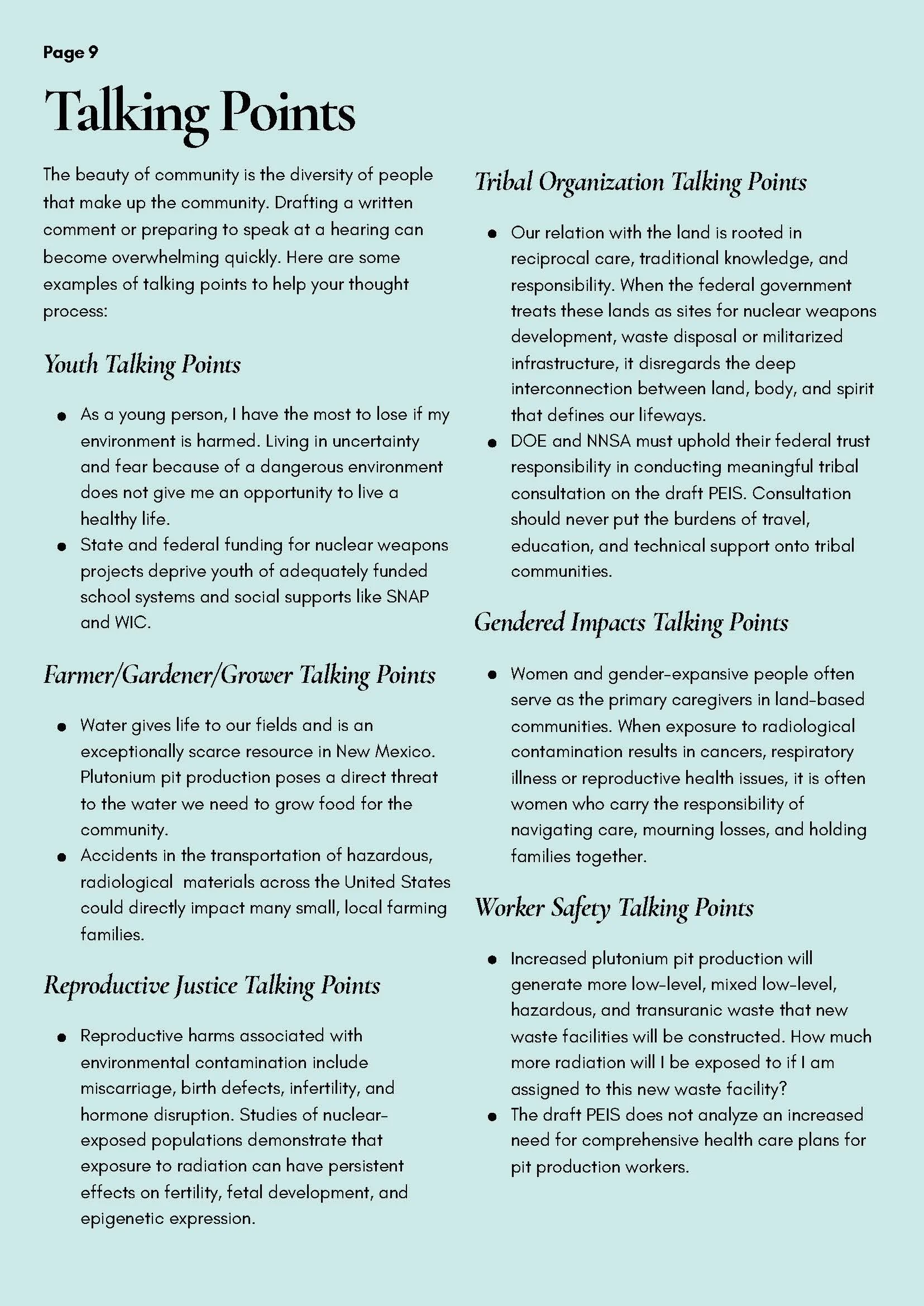
Here are some more talking points folks could use in drafting public comments:
Surface water
The Rio Grande, listed as the United State’s most endangered river in 2024, is a vital lifeline for millions of people and ecosystems - from New Mexico to Mexico. Expanded plutonium pit production poses grave threats to further damage the river, through the inevitability of stormwater runoff carrying radioactive and other harmful wastes.
The PEIS fails to address, or even mention, surface water legacy waste issues in New Mexico. These historic issues continue to impact our fragile waterways and expanding plutonium pit production, while leaving prolific legacy waste in New Mexico’s vital waterways is unacceptable and increases the dangers of environmental threats to our communities.
The PEIS does not address inevitable climate change impacts that have and will continue to accelerate widespread surface water contamination. Wildfires are increasing in frequency and severity due to the impacts of climate change and the 25-year megadrought in New Mexico. Wildfires and the loss of vegetation accelerate erosion and flooding, moving (potentially) undisturbed contaminants into New Mexico’s waterways and our communities.
The PEIS fails to address the systemic harm, both historic and ongoing, caused by LANL’s nuclear weapon production inflicted on surrounding Pueblos and homes of Land-Based Peoples. The PEIS must address and fully evaluate the disproportionate cultural health risks to these communities and prioritize protecting those most vulnerable. The surrounding Pueblos and crop lands are directly downstream from LANL, meaning that the inevitable surface water runoff from the lab goes directly to these communities, draining into acequias, fields, and local waterways.
Groundwater
The PEIS discusses groundwater through a regulatory lens but fails to discuss water in relation to the ecosystem and people. The NNSA must name the cultural harm.
Contamination of any amount of water at any level, even below regulatory levels, can disrupt ceremonial use and sever intergenerational relationships with place.
NNSA needs to demonstrate how they will prevent additional groundwater contamination from the hexavalent chromium plume, remediate existing threats, and place additional structures to ensure future compliance. The Pueblo communities harmed by this contamination should also be notified, included as stakeholders, and given reparations.
The PEIS does not discuss how expanded pit production impacts water rights and traditional water use for the Pueblo de San Ildefonso.
The NNSA must consider the consequences for groundwater in the case of an accident, leakage, or aging equipment.
Española Basin Sole Source Aquifer (EBSSA)
LANL is located above the federally designated Española Basin Sole Source Aquifer (EBSSA). The EBSSA covers over 3,000 square miles over northern New Mexico. Over 135,000 people depend on this aquifer every day. It is a faulted, hydraulically connected system that is vulnerable to plume migration.
LANL/DOE must prioritize the clean up of the existing hexavalent chromium plume above plutonium pit production.
Despite the DOE’s contention that legacy waste is outside the scope of the PEIS, the existence and lack of remediation of this waste presents an important reason for why LANL is not a suitable location for expanded plutonium pit production.
The Draft PEIS recognizes that “detections of nitrate, perchlorate, chromium, and 1,4-dioxane at MCOI-6” exceeded groundwater quality standards in LANL’s groundwater monitoring well samples.” This contradicts the PEIS argument that LANL impacts to the groundwater are slow and negligible.
LANL has unsuccessfully attempted to stop the spread of the hexavalent chromium plume for 20 years already demonstrates that there is still a lack of understanding of the dimensions of the chromium plume and the speed of groundwater travel.
The Parajito Plateau is seismically fractured, providing ready pathways for contaminant migration to deep groundwater.
Intergenerational Impacts
The Draft PEIS fails to evaluate health risks using a framework that prioritizes the most vulnerable populations—including fetuses, infants, children, and pregnant or nursing people—and should instead adopt a "no release/no exposure" alternative for all plutonium pit production activities.
The PEIS does not adequately assess the multi-generational impacts of radiological and toxic exposures, despite evidence that some contaminants can cross the placenta and affect reproductive health across multiple generations.
Radiation risk assessments presented in the PEIS are based on the general population and do not calculate risks specifically for fetuses, infants, children, or pregnant people, even though these populations are significantly more susceptible to harm.
NNSA should conduct and disclose cumulative health analyses on birth defects, miscarriages, infant mortality, reproductive health, and other developmental impacts before authorizing expanded plutonium pit production.
The PEIS should include a comprehensive cumulative exposure assessment that accounts for historic and ongoing releases of radionuclides and hazardous chemicals, while continuing efforts such as the Los Alamos Historical Document Retrieval and Assessment (LAHDRA) project.
The analysis fails to account for Indigenous and land-based exposure pathways, including traditional food gathering, hunting, fishing, farming, medicinal plant use, pottery making, ceremonial water use, and other cultural practices that may increase cumulative exposures.
Independent studies are needed to evaluate contamination of traditional foods, agricultural soils, acequia systems, waterways, and other environmental resources, with funding for community monitoring, remediation, and compensation where contamination is identified.
Current radiation protection standards are inadequate because they are based on a reference adult male and do not reflect the biological vulnerabilities of women, infants, Indigenous lifeways, or environmental justice communities.
The PEIS does not adequately evaluate tritium releases (byproduct of plutonium production), ALARA compliance, or alternatives to radioactive emissions, nor does it provide sufficient transparency regarding modeling, monitoring, emergency determinations, or decision-making for planned releases.
Although DOE acknowledges that LANL operations will continue to generate unavoidable radioactive and chemical releases affecting workers, the public, and watersheds draining to the Rio Grande, the PEIS fails to fully evaluate the cumulative environmental and public health consequences of expanding plutonium pit production over the next 50 years.
Cultural Resources
The Draft PEIS does not adequately evaluate impacts to Tribal cultural resources, sacred sites, or Indigenous cultural landscapes associated with expanded plutonium pit production.
The analysis relies on a narrow archaeological framework that focuses on physical damage to individual sites, rather than recognizing broader Tribal cultural landscapes, sacred places, traditional use areas, and living cultural relationships.
Water is treated primarily as a utility or environmental resource instead of a living cultural, spiritual, ceremonial, and subsistence resource that is central to many Tribal Nations and Pueblos.
The PEIS fails to assess how groundwater withdrawals, contamination risks, wastewater, legacy pollution, and cumulative impacts could affect Tribal relationships with culturally significant waters and traditional practices.
Archaeological surveys cannot substitute for Tribal knowledge. Many sacred sites, Traditional Cultural Properties, and cultural landscapes can only be identified through confidential government-to-government consultation.
NNSA improperly defers cultural resource analysis to future project-level Section 106 compliance instead of evaluating cumulative, programmatic impacts at the PEIS level for a proposed 50-year mission.
The PEIS should evaluate impacts beyond physical land disturbance, including effects on Tribal access, ceremonial practices, traditional ecological knowledge, viewsheds, culturally significant plants and animals, and the integrity of interconnected cultural landscapes.
Previously disturbed or developed lands should not be presumed free of cultural significance, as they may remain part of living Indigenous cultural landscapes and reflect cumulative impacts from decades of nuclear weapons activities.
The Final PEIS should include a Tribally informed cultural landscape analysis developed through early, meaningful, and confidential government-to-government consultation, along with enforceable mitigation measures such as avoidance of sacred sites, Tribal monitoring, access protections, and Tribally led cultural studies.
The PEIS fails to evaluate the intergenerational cultural consequences of committing future generations to at least 50 years of plutonium pit production, including impacts on the transmission of language, cultural practices, stewardship responsibilities, and continued care for ancestral lands and sacred places.
Cumulative Impacts
Chapter 5 of the Draft PEIS identifies five resource areas for cumulative impacts analysis but excludes cultural resources entirely, despite LANL's documented relationships with 16 Tribes and Pueblos within a 50-mile radius
The Mortandad watershed, a documented contamination corridor running from LANL's TA-55 and TA-50 directly through Pueblo de San Ildefonso land, receives no cumulative impact analysis in Chapter 5
The PEIS acknowledges Accord Pueblo agreements with San Ildefonso, Santa Clara, Cochiti, and Jemez designed to address shared environmental concerns, yet none of those Pueblos appear in the cumulative impacts chapter
50 years of expanded pit production will generate cumulative impacts on Tribal sacred sites, water rights, traditional use areas, and health that the PEIS never analyzes
LANL's projected water consumption of up to 1,548 acre-feet per year under expanded operations is not analyzed for cumulative effects on Tribal water rights in the Rio Grande watershed
NNSA's own footnote (Footnote 39, Vol. 1, p. 4-107) reveals that approximately 21,500 cubic meters of projected TRU waste requires regulatory approvals not yet obtained before WIPP can legally accept it
Without those regulatory approvals, effective remaining WIPP capacity drops to roughly 1,064 cubic meters -- less than one year of TRU waste generation at maximum production
A WIPP capacity shortfall would force extended on-site TRU waste staging at LANL, increasing the exact prolonged storage exposure risks already flagged as high-consequence scenarios in the PEIS accident risk tables
TRU waste transport routes from LANL to WIPP pass through or near multiple Tribal communities and Pueblo traditional territories in northern and central New Mexico -- a cumulative risk that goes unanalyzed
The PEIS cannot conclude that WIPP operational capabilities will not be adversely affected while a 21,500 cubic meter gap in regulatory authorization remains buried in a footnote and unresolved in the body of the document
Worker Safety
Worker safety is not adequately considered in the DRAFT PEIS. Rightly stated in the DRAFT PEIS Summary, “The Nation’s capability to produce plutonium pits is limited and does not meet federal requirements” (S-1).
The Savannah River Plutonium Processing Facility (Savannah River Site), in Aiken, South Carolina, remains incapable of pit production twelve years after 50 U.S.C. § 2538a. “Workforce,” in part, defines the physical infrastructure of the Nuclear Security Experience, yet worker safety is seldom addressed in the DRAFT PEIS.