Area G and the effects it has on us and the environment
by R’riana Frenier
What is Area G?
Area G is a Material Disposal Area (MDA) site on the Mesita del Buey at Los Alamos National Laboratory (LANL). It is a legacy waste management area used for storing radioactive TRU (transuranic) waste and low-level radioactive waste. “Area G is located on top of a mesa and is 1.3 miles north of the White Rock residential community and is about 600 feet west of the Pueblo of San Ildefonso” (Department of Energy, 2025). Area G and San Ildefonso share a boundary, but according to the Pueblo of San Ildefonso, several sacred sites within the bounds of LANL were taken, and are now contaminated making these sacred sites inaccessible to the Pueblo, which is rightfully entitled to them. Examples include the Pajarito Plateau, and Nake’muu, a small village that lies on the edge of the mesa. Within Nake’muu, there are cave dwellings and roomblocks. In addition, the Pajarito Plateau’s aquifers are now contaminated with radioactive waste.
What is transuranic waste?
Transuranic waste is radioactive waste contaminated with elements heavier than uranium. Examples include plutonium, neptunium, americium, and curium. The Waste Isolation Pilot Plant (WIPP), near Carlsbad, New Mexico, is the only designated location in the United States where transuranic waste can be “safely” disposed underground. Numerous accidents at WIPP point to serious flaws for safe disposal and lead to various problems:
1. LANL does not have another plan for this toxic waste in the event that a problem arises with WIPP.
2. Most importantly, WIPP was supposed to close in 2024. The Department of Energy (DOE) decided that WIPP will remain open until 2083 for transuranic waste being shipped from across the country, including from LANL.
3. Transporting transuranic waste can be very dangerous. Scenarios such as: a person handling the transuranic waste will suffer radiation exposure if not properly handled. The waste could also leak out of the drums, or a transportation accident could occur during transport, causing the drums to release radioactive waste into the environment, or cause harm to living organisms, including people.
What is intermediate-level waste (ILW) (also known as mixed radioactive waste)?
Intermediate level waste (ILW) is “a type of radioactive waste that falls between low-level waste (LLW) and high-level waste (HLW) in terms of its radioactivity and heat generation” (ScienceDirect, 2012). Some of the elements stored at Area G fall under this category.
How are these elements being taken care of at Area G, and are they harmful to the environment and/or humans?
At Area G, drums are being stored above-ground under canvas tents. They are also buried underground in unlined trenches, pits and shafts in volcanic tuff. These drums are made of different types of steel, including carbon steel and stainless steel, but some drums are also made with lead and even concrete. These drums hold transuranic waste and other radioactive materials, but there is a big problem with the location of Area G, because adjacent to it is housing. There are also questions about whether the developer was required to inform the homeowners that right next to their expensive homes there are harmful, radioactive elements that are being stored and buried. This is important for people to be aware of, especially because these elements are very dangerous and can cause harm to living organisms, including people.
For example:
Neptunium can cause bone, liver, and lung cancer due to radiation. Neptunium can also accumulate in bones and potentially lead to a cancer risk in bone tissue (Lenntech, 2025).
Americium primarily releases alpha particles, which can cause serious damage to surrounding cells. Americium also releases gamma radiation, which could penetrate the body and cause cellular damage. Americium tends to accumulate in the bones, liver, and muscles. Once inside the body, americium can remain for many decades and can continuously irritate these organs and increase the risk of developing cancer (Agency For Toxic Substances And Disease Registry, 2004).
Curium accumulates in bone tissue, where its radiation can cause significant damage to surrounding cells and tissue, which may lead to an increased risk of bone tumors. It can also cause lung and liver cancer (Lenntech, 2025).
Plutonium has the biggest risks of all the elements. Plutonium, like all other elements, can cause cancer primarily in the bone, lung, and liver. But if someone is exposed to a high dose of plutonium, it can cause severe health issues, for example, ischemic heart disease, skin burns, gastrointestinal distress, hair loss, nausea, and even death (Bundesamt für Strahlenschutz, 2021).
Not only do these elements pose serious health risks for nearby homeowners, but if a family is planning to have a child, or if a woman is pregnant, the fetus could experience stunted growth, deformities, abnormal brain function, and an increased risk of childhood cancer later in life. These elements could also cause the mother to have a miscarriage.
Children and fetuses are more prone to radioactive damage than adults because they have less developed tissues and their cells rapidly divide, causing them to have an increased risk of developing cancer and other radiation risks (Agency For Toxic Substances And Disease Registry, 2004); (US Centers for Disease, Control and Prevention, January 2025).
How could communities be exposed to these elements?
LANL is surrounded by the Santa Fe National Forest, where forest fires have already happened in the past and have had to be redirected. For example, the Cerro Grande fire in the early 2000s started as a controlled burn, but because of the drought conditions and heavy winds, it quickly turned into an uncontrolled burn, destroying almost everything in its path. The fire burned 7,000 acres of LANL. In the northern area of LANL and near the Los Alamos townsite, the fire was redirected toward Pueblo lands. The fire came very close to the gates at Area G and public concern rose as it moved towards the storage areas. If a wildfire were to have spread to the canvas tents, where 40,000 TRU waste drums were being stored at Area G, radioactive materials would have been released into the air, water, and soil. These radioactive materials could contaminate the public's water supply, including groundwater, river water, wells, fields and orchards.
When the waste materials are improperly packaged or mixed with other contents of the container, it could potentially rupture the container's seal by increasing the contents’ internal pressure. If the containers are not sealed or vented, the containers’ seals can rupture and expose more waste into the air.
In the past, nuclear waste was dumped and buried directly in the ground. This allows the waste to eventually seep into the soil and groundwater.
Aged radioactive waste stored in tanks can leak and contaminate the soil surrounding the tank.
Radioactive waste released into the atmosphere can be deposited on plants and go into the soil by precipitation. Precipitation can push the waste that was contaminated in the soil further down into the earth. Plants can also push contaminated waste deeper into the soil through their roots.
Lastly, toxic waste can be transported into the groundwater through the waste leaching onto poorly contained soil. The release of toxic wastewater can also contaminate groundwater.
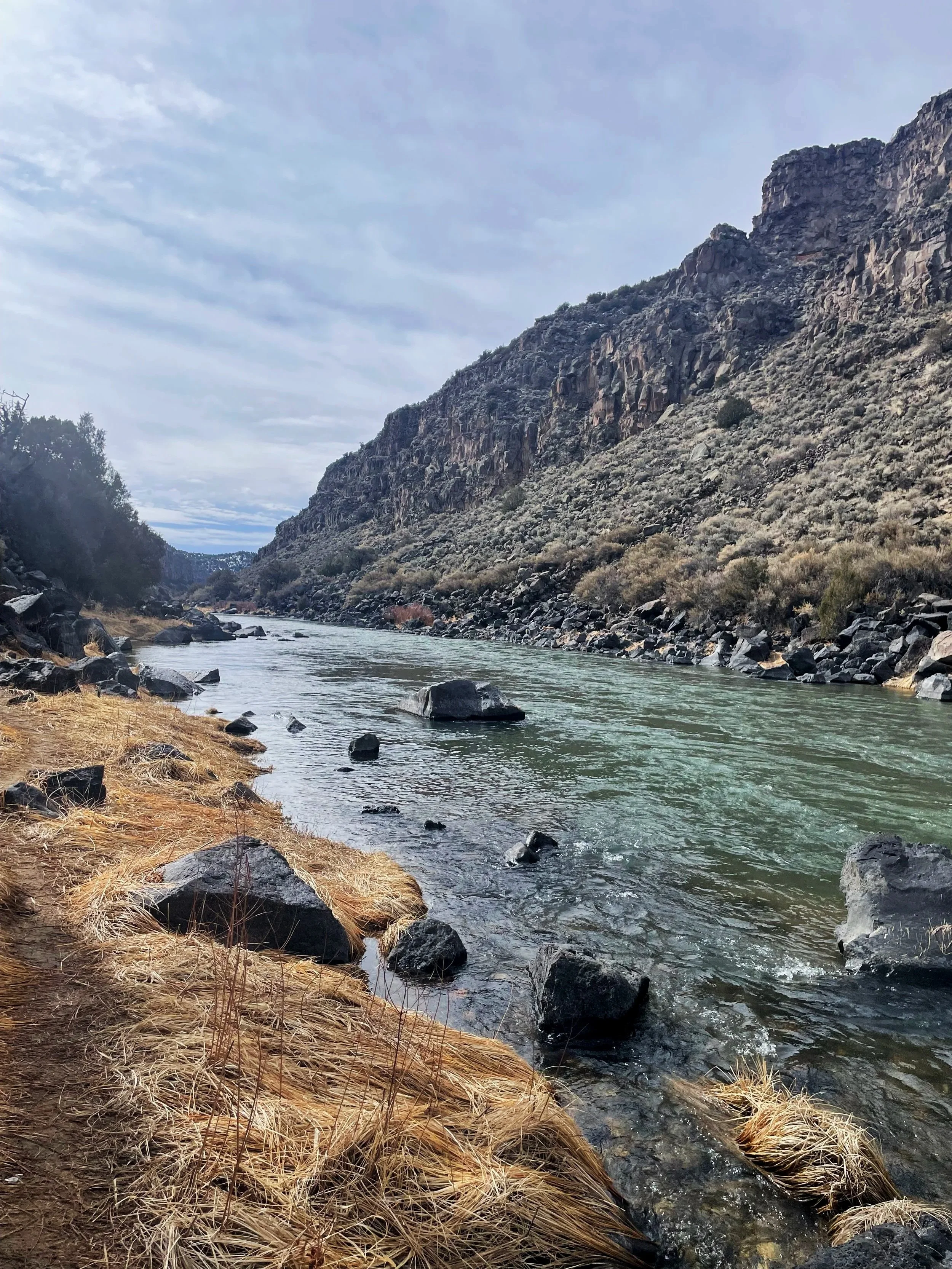
Rio Grande, photo by Kalyn Mae Finnell
Transuranic waste from LANL is seeping into the groundwater and moving into the Rio Grande. Contamination of the air and the Rio Grande impacts the Pueblos of San Ildefonso, Pojoaque, Nambe, Tesuque, San Juan, Taos, Cochiti, Santo Domingo, San Felipe, Santa Ana, Sandia, Jemez, and Isleta. It is also affecting the cities of Española, Santa Fe, Albuquerque, Las Cruces, Rio Rancho, Socorro, Belén, El Paso, Del Rio, Laredo, McAllen, Brownsville, Harlingen, Pharr, Hidalgo, Ciudad Juárez, Ojinaga, Ciudad Acuña, Piedras Negras, Nuevo Laredo, Reynosa, Matamoros. These cities and Pueblos rely on the Rio Grande as a primary water source. Altogether, about 16 million people rely on the Rio Grande for drinking water and other essentials. All these living organisms, including people, are potentially getting exposed to transuranic waste and other contaminants increasing their chances of exposure to the dangerous effects of these toxic materials.
Contaminated water results in less available clean water for day-to-day life and activities of land-based Pueblos. This results in the loss of access to water for sacred ceremonies, including watering crops, going to the river, fishing, hunting, etc.
LANL must be stopped from generating more nuclear, toxic and hazardous waste. LANL should also be held accountable to the cleanup of existing waste. We deserve a waste-free future and clean waters.
Steps you can take: Get Involved! Talk with your friends and neighbors! Support the communities and the activism of groups such as Communities for Clean Water, as they work to protect water.

R’riana Frenier is a 14-year-old honor roll student at Santa Fe Indian School. She is from the Pueblos of Tesuque, Jemez, and Santa Clara, and belongs to the Sun, Fox, and Badger clans, which shape her identity and connection to her community. Through her writing, leadership, and work as an Indigenous model, Frenier is dedicated to raising awareness of environmental issues and uplifting Indigenous youth voices. R’riana is a CCW youth member and was a member of the CCW Youth Cohort in 2025.
Sources:
Agency For Toxic Substances And Disease Registry. (April 2004). Public Health Statement, Americium. https://www.atsdr.cdc.gov/toxprofiles/tp156-c1-b.pdf
Bundesamt für Strahlenschutz. (September 9, 2021). Plutonium. https://www.bfs.de/EN/topics/ion/effect/radioactive-materials/plutonium/plutonium.html
Communities For Clean Water. (2025). The Evidence. https://www.ccwnewmexico.org/the-evidence-1#:~:text=Radioactive%2C%20hazardous%20and%20toxic%20waste,and%20alter%20behavior%20in%20animals.
Department of Ecology State of Washington. (2024). Hanford leaking tanks. https://ecology.wa.gov/waste-toxics/nuclear-waste/hanford-cleanup/leaking-tanks#:~:text=Energy%20announced%20in%20April%202021,101%2C%20into%20the%20order's%20requirements.
Kellman, S. (November 3, 2009). Rio Grande Threatened By Radioactive Run-off. Circle of blue: where water speaks. https://www.circleofblue.org/2009/world/rio-grande-threatened-by-radioactive-run-off/#:~:text=Radioactive%20waste%20is%20trickling%20toward,human%20health%20and%20the%20environment.
Lenntech. (2025). Neptunium - Np. https://www.lenntech.com/periodic/elements/np.htm
Lenntech. (2025). Curium - Cm. https://www.lenntech.com/periodic/elements/cm.htm
Los Alamos Study Group (various organizations). (January 15, 2002). Re: We request cessation of nuclear waste disposal at Los Alamos National Laboratory's "Area G" landfill and formal closure of the site, as required by law. https://lasg.org/waste/area-g-letter-maggiore.htm#:~:text=Environmentally%2C%20Area%20G%20is%20a%20poor%20site%2C%20and%20should%20close&text=Most%20of%20the%20waste%20has,as%20tritium%20and%20strontium%2D90.
NB3 Los Alamos. (Accessed November 2025). TRU Waste Management at Area G: Management of transuranic waste storage, characterization, and remediation. https://n3b-la.com/area-g-tru/.
Naranjo, M & Sanchez, K. (July 19, 2024). DOE’s National Nuclear Security Administration Needs to Acknowledge Growing Tribal and Public Concern. Tewa Women United. https://tewawomenunited.org/2024/07/does-national-nuclear-security-administration-needs-to-acknowledge-growing-tribal-and-public-concern
National Research Council (US) Committee on the Biological Effects of Ionizing Radiations. (1988). Health Risks of Radon and Other Internally Deposited Alpha-Emitters: BEIR IV. National Academies Press (US). https://www.ncbi.nlm.nih.gov/books/NBK218114/.
Office of Environmental Management. (November 23, 2021). Los Alamos Continues Groundwater Sampling Along The Rio Grande Amid Drought. U.S Department of Energy. https://www.energy.gov/em/articles/los-alamos-continues-groundwater-sampling-along-rio-grande-amid-drought.
United States Environmental Protection Agency. (July 29, 2025). Radioactive Waste From Uranium Mining and Milling. https://www.epa.gov/radtown/radioactive-waste-uranium-mining-and-milling#:~:text=Uranium%20eventually%20decays%20to%20radium,it%20is%20inhaled%20by%20miners.
United States Environmental Protection Agency. (August 28, 2024). Transuranic Radioactive Waste (TRU). https://iwaste.epa.gov/guidance/radiological-nuclear/transuranic-waste
US Centers for Disease, Control and Prevention. (January 2025). Radiation and Pregnancy: Information for Clinicians. https://www.cdc.gov/radiation-emergencies/hcp/clinical-guidance/pregnancy.html